
Tensiomyography (TMG) is a diagnostic tool for determining the contractile properties of muscles and how they change over time. It was developed in the late 1980s and was basically designed for medical use. In the 1990s, it was also used in the field of elite sport and recreation.
Measurement results
The TMG results also describe the functional state of the muscles. Therefore, TMG has a great advantage in the field of pre- and post-operative diagnosis and in the field of determining the damage caused to a particular muscle. Other mechanical methods, such as isokinetics, treadmills and bilateral pressure plates, can be used later in the rehabilitation process (late rehabilitation), as the patient has to develop a certain muscular force on all the above-mentioned apparatus, which in turn can cause further damage to the already damaged or operated soft tissues.
Periodic monitoring of muscle contractile parameters allows us to plan training for muscle strength and activation at different stages of an athlete’s training.
TMG is used to determine the contractile properties of muscles (contraction time, tone) and symmetries or asymmetries between muscles and joints. Using normative values: gender and sport discipline, we can objectively assess an individual’s muscular condition. The assessment of muscular condition determines the talent of a young athlete for a specific sport discipline (explosive sports, endurance sports). The parameters obtained from this type of measurement can be usedto monitor progress in muscle rehabilitation after injury or progress in sports training.
We recommend TMG muscle analysis to all young athletes before choosing the sport discipline (SPORT TALENT) they want to play. It is also recommended for all recreational athletes who want better sports results or a more controlled training process.
TMG diagnostics are useful for:
- optimising your training
- preventing injury
- injury rehabilitation
How does it work?
The measurement process is completely painless and quick.
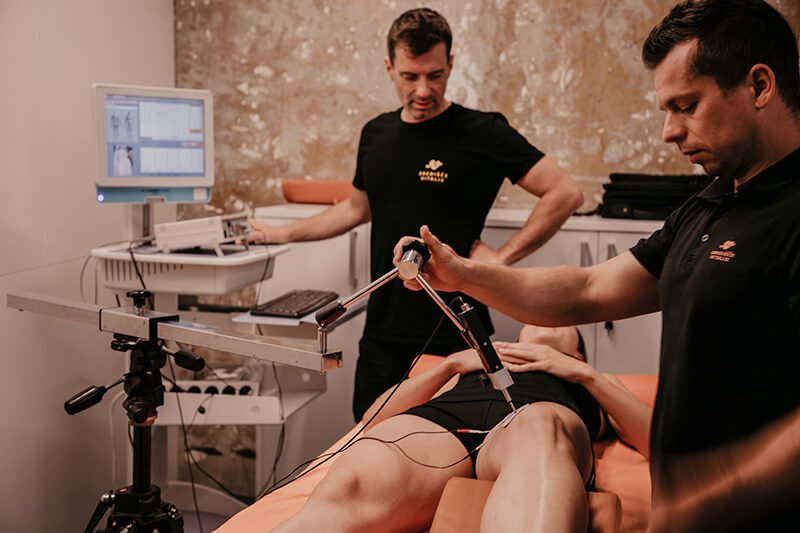
A TMG expert, or usually two experts, will work with you on the table. One optimally positions the sensors at standard points on the body, the other reads the results on a monitor.
The displacement sensor is placed on the skin over the muscle, which is artificially stimulated with electrodes. The sensor measures the displacement and acquires time-resolved characteristics of the individual muscle. The results are displayed on a monitor in real time in the form of curves. The dynamic response of the sensor is measured in milliseconds, which allows to distinguish between fast and slow muscle fibres.
The whole measurement takes between 30-45 minutes, followed by a consultation on the results.
The TMG muscle analysis is suitable for all professional athletes and recreational athletes who want better sports results or a more controlled training process. It is also suitable for the elderly population as it measures symmetry between muscles.